USM EMBEDS SUSTAINABILITY AT THE CORE OF FISCAL GOVERNANCE IN STRATEGIC INSTITUTIONAL SHIFT
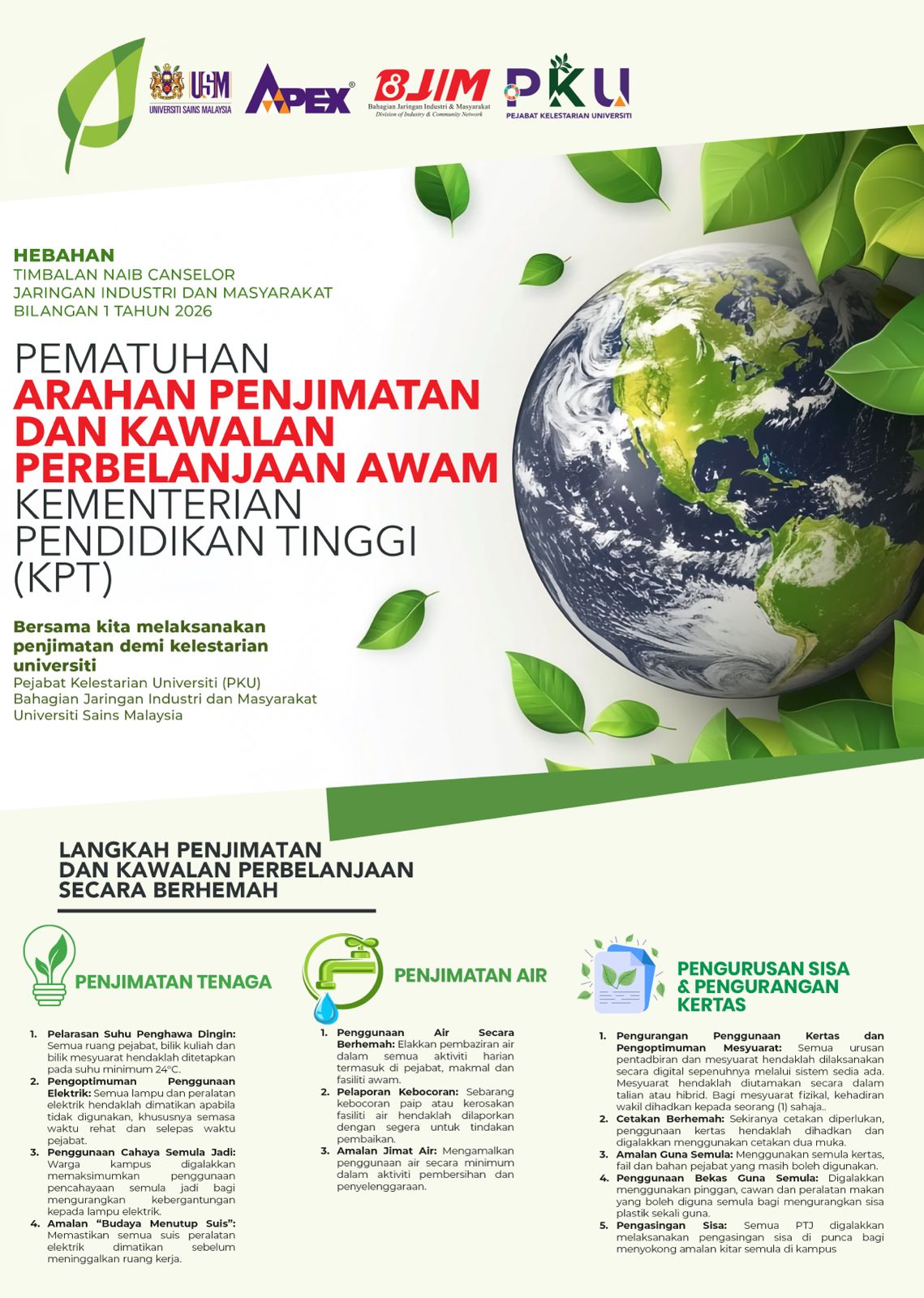
USM, PENANG, 14 April 2026 – Universiti Sains Malaysia (USM) has reinforced its institutional commitment to prudent financial management by formalising a directive aligned with national expenditure optimisation measures set by the Ministry of Higher Education (MOHE). The circular, issued under the Deputy Vice-Chancellor of the Bahagian Jaringan Industri & Masyarakat (BJIM) in collaboration with the Pejabat Kelestarian Universiti (PKU), signals a strategic shift in how the university operationalises cost governance within a sustainability-driven framework.
Rather than treating expenditure control as a reactive administrative requirement, USM is embedding resource efficiency as a core institutional principle. This approach reframes energy consumption, water utilisation, and material use particularly paper not merely as operational considerations but as measurable indicators of accountability and governance quality.
The directive forms part of USM’s broader transformation agenda under its APEX mandate, where efficiency, sustainability, and governance excellence are positioned as key institutional priorities.
A notable feature of the initiative is its emphasis on behavioural recalibration. Practical measures such as optimising air conditioning settings, moderating electricity usage, and maximising natural lighting are designed to cultivate consistent organisation wide habits. These interventions reflect an understanding that sustainable cost savings are often achieved through disciplined daily practices rather than large scale structural changes alone.
Water management is addressed with equal priority. The directive calls for stringent monitoring and elimination of wastage across offices, laboratories, and shared facilities. The inclusion of laboratories underscores recognition of their intensive resource demands, while mandatory reporting of leakages introduces a clear accountability mechanism. Attention is also given to less visible consumption points including cleaning and maintenance operations ensuring a comprehensive approach to conservation.
Institutional alignment further strengthens the initiative. The coordinated role of PKU and BJIM illustrates how sustainability and financial governance are being integrated across administrative functions. This cross functional engagement moves expenditure management beyond traditional finance units embedding responsibility within operational, environmental, and community facing domains.
Digitalisation is another key pillar of the framework. The increased adoption of virtual and hybrid meetings alongside reduced reliance on printed materials reflects a dual objective of lowering operational costs while enhancing administrative efficiency. Over time these shifts are expected to contribute to more agile and streamlined institutional workflows.
At a broader level the directive reflects an evolving perspective within public universities. Fiscal constraints are no longer viewed solely as limitations but as catalysts for institutional innovation. By leveraging these constraints universities can sustain academic and research excellence while improving operational resilience and environmental stewardship.
USM’s approach demonstrates a calibrated and forward-looking response to national policy expectations. By integrating sustainability into cost governance and distributing accountability across its organisational structure the university is advancing a model that balances compliance with strategic adaptability ultimately strengthening its capacity to deliver on its educational research and societal missions.
Vice-Chancellor of USM, Professor Dato’ Seri Ir. Dr. Abdul Rahman Mohamed said that the directive reflects a deliberate shift in institutional mindset where financial discipline and sustainability are no longer treated as parallel priorities but as mutually reinforcing imperatives.
“We are moving beyond cost control as a compliance exercise and positioning it as part of a broader governance philosophy. By embedding sustainability into our daily operations, we are strengthening institutional resilience while ensuring that every resource entrusted to us is managed with accountability and purpose,” the Vice-Chancellor said.
He added that the approach also reflects USM’s responsibility as a leading public university to set benchmarks in governance practices that are both efficient and environmentally conscious.
“This is about cultivating a culture where every member of the university community recognises their responsibility in managing resources with discipline and accountability. Small, consistent actions, when institutionalised at scale, can deliver meaningful long-term impact,” he added.
Text: PrivinKumar Jayavanan, Media & Public Relations Centre (MPRC) / Editing: Associate Professor Dr. Shaik Abdul Malik Mohamed Ismail, Senior Editorial Consultant @ MPRC USM
- Created on .
- Hits: 346
