USM SATELLITE-ENABLED UAV COMMUNICATION RESEARCH SECURES PPRN GRANT, REINFORCING MALAYSIA’S NEXT-GENERATION AIRSPACE CAPABILITIES
KUALA LUMPUR, 9 April 2026 — A strategic research collaboration between Universiti Sains Malaysia (USM) and AIM Aerial Technologies Sdn. Bhd. has been accorded recognition under the Public-Private Research Network (PPRN) 2026, highlighting a cutting-edge advancement in unmanned aerial vehicle (UAV) communication systems designed for complex and extended-range operations.
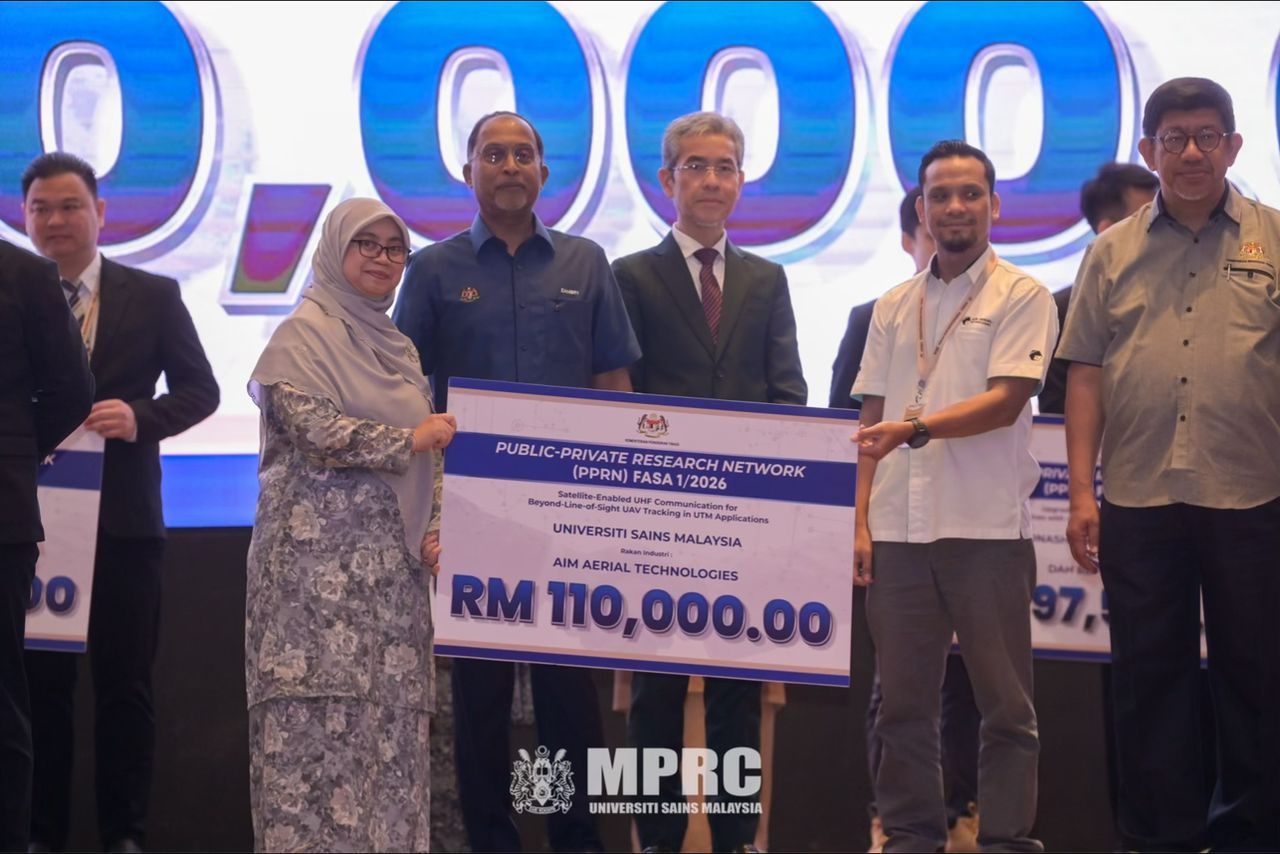
Showcased at the Persidangan Public-Private Research Network (PPRN) 2026 held at Wyndham Grand Bangsar Kuala Lumpur, the project titled “Satellite-Enabled UHF Communication for Beyond-Line-of-Sight UAV Tracking in UTM Applications” introduces a transformative solution to one of the most persistent operational constraints in UAV deployment reliable, beyond-line-of-sight (BLOS) communication.
The initiative is led by Dr. Norilmi Amilia Ismail from USM’s School of Aerospace Engineering, in partnership with AIM Aerial Technologies Sdn. Bhd. It addresses critical limitations inherent in current UAV Tracking Management Systems (UTM), which are predominantly dependent on terrestrial communication infrastructures such as 5G LTE and LoRa networks. These systems typically restrict UAV tracking capabilities to a range of 2–5 kilometres in urban settings and 10–15 kilometres in rural environments, thereby constraining mission scope, particularly in remote or infrastructure-limited regions.
The USM-developed solution introduces a satellite-enabled communication architecture that integrates ultra high frequency (UHF) transceivers with low Earth orbit (LEO) satellite systems. This approach enables UAVs to transmit real-time telemetry data, including positioning and operational parameters, directly to orbiting satellites, which then relay the information to ground stations and centralised control platforms. By decoupling UAV communication from terrestrial network dependencies, the system establishes continuous, resilient tracking capabilities across geographically dispersed and otherwise inaccessible areas.
Importantly, the system is engineered in alignment with regulatory requirements set by the Malaysian Communications and Multimedia Commission (MCMC), particularly in relation to UHF spectrum utilisation for satellite communication. This ensures that the innovation not only advances technical performance but also operates within established national compliance frameworks, minimising interference risks and supporting scalable deployment.
From a performance perspective, the project is expected to elevate system effectiveness from 70 per cent to 90 per cent, significantly enhancing signal stability, reducing data transmission losses, and strengthening real-time situational awareness. These improvements correspond to an estimated 28.6 per cent increase in operational productivity. In parallel, the industry partner projects revenue growth from RM300,000.00 to RM500,000.00 annually, reflecting the commercial viability and market relevance of the technology.
Supported by a total grant allocation of RM110,000.00 under the PPRN framework, the project represents a focused yet high-value investment in advancing Malaysia’s UAV ecosystem. It also exemplifies a mature model of academia–industry synergy, where engineering innovation is closely integrated with regulatory readiness and industry application.
Vice-Chancellor of USM, Professor Dato’ Seri Ir. Dr. Abdul Rahman Mohamed, contextualised the development within a broader global research and innovation trajectory:
“The future of autonomous and remotely operated systems will be defined not by isolated technological advances, but by the integration of resilient communication architectures that can operate seamlessly across borders, terrains, and infrastructures. This work reflects the kind of translational research universities must prioritise where fundamental engineering is extended into deployable systems that shape industry standards, inform regulatory evolution, and contribute to technological sovereignty.”
He further emphasised that universities must function as active nodes within global innovation ecosystems rather than as purely knowledge-generating institutions:
“In a deeply interconnected innovation landscape, the mandate of a research university extends beyond knowledge creation to orchestrating expertise, systematically mitigating technological uncertainties, and expediting the transition from discovery to deployment. This collaboration illustrates how rigorously grounded academic research, when strategically aligned with industry priorities, can yield solutions of both technical distinction and international relevance.”
As highlighted at PPRN 2026, innovations of this nature are instrumental in redefining operational paradigms within the UAV sector. In an era where aerial systems are increasingly deployed across expansive and heterogeneous environments, the capacity to sustain reliable, beyond-line-of-sight communication is no longer a technical aspiration but a foundational requirement.
Source: Dr. Norilmi Amilia Ismail, School of Aerospace Engineering / Text: Privinkumar Jayavanan, Media & Public Relations Centre (MPRC) / Editing: Associate Professor Dr. Shaik Abdul Malik Mohamed Ismail, Senior Editorial Consultant @ MPRC USM / Photo: Muhamad Faris Dawisy Mohammad Rafiq, Media & Public Relations Centre (MPRC)
- Created on .
- Hits: 2717
