USM SOCSC ACADEMIC SEMINAR SERIES 2/2026 LOOKS AT THE GLOBAL SOUTH’S ROLE IN A TRANSITIONING WORLD ORDER
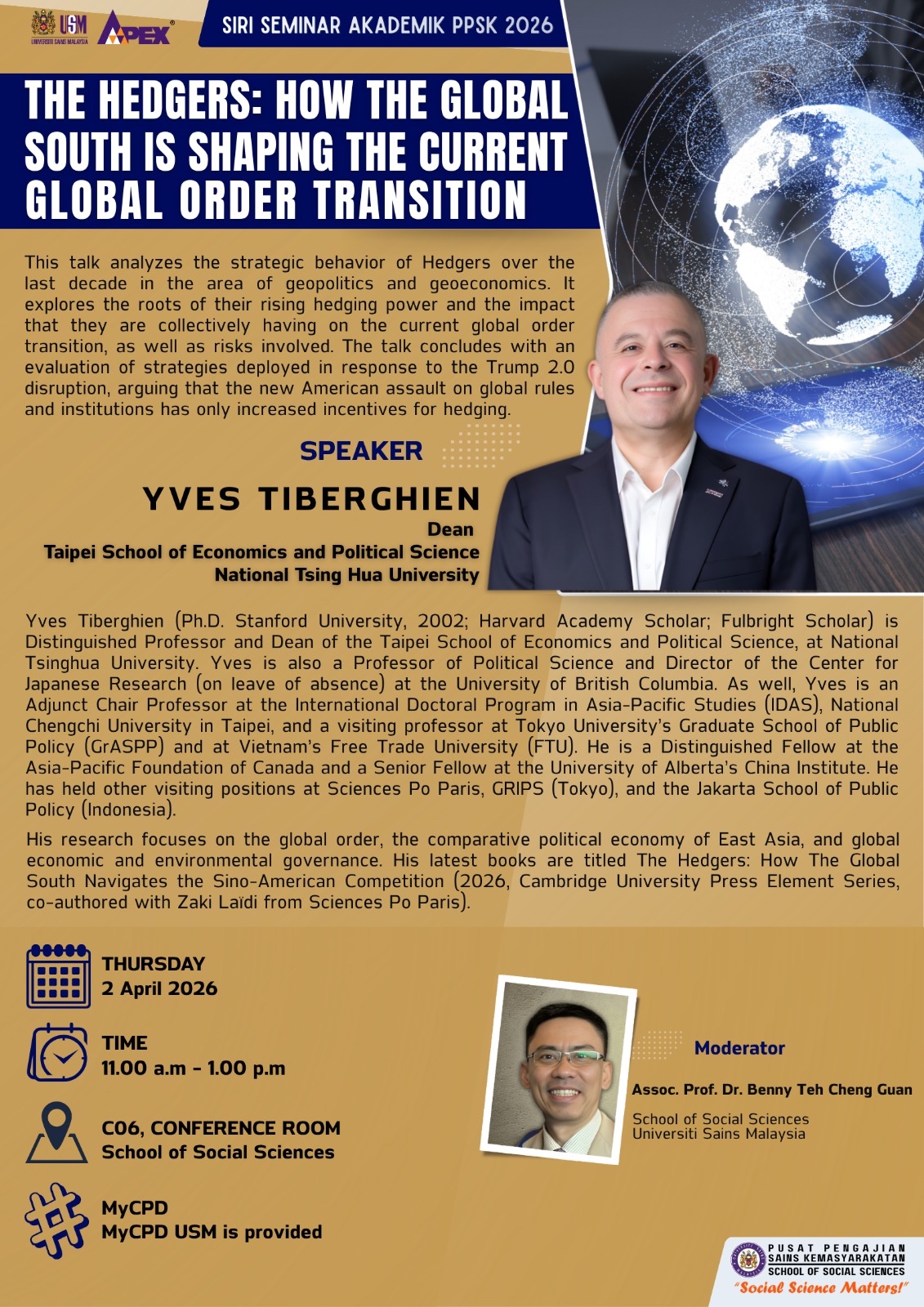
USM PENANG, 2 April 2026 – The School of Social Sciences at Universiti Sains Malaysia (USM) held its SocSc Academic Seminar Series 2/2026 today, focusing on current changes in global politics.
The seminar, titled “The Hedgers: How the Global South is Shaping the Current Global Order Transition,” was presented by Professor Yves Tiberghien, Dean of the Taipei School of Economics and Political Science at National Tsing Hua University, Taiwan.
It took place at Conference Room C06, School of Social Sciences, and was moderated by Associate Professor Dr. Benny Teh Cheng Guan.
The seminar attracted academic staff, postgraduate researchers, and students, showing strong interest in global governance issues.
The main idea of the seminar was the concept of “hedging” as a key strategy used by Global South countries in the past decade.
Tiberghien explained that hedging is not just passive balancing, but a deliberate and flexible strategy used by middle and emerging powers to deal with uncertainty in a divided world system.
He said, “Instead of strictly siding with major powers, states in Asia, Africa, and Latin America are diversifying their political, economic, and security ties. This multi-directional approach helps them reduce risks while keeping independence.”
“This was linked to the growing economic competition, especially between the United States and China,” he added.
A major part of the talk focused on the effects of rising protectionism and unilateral actions in global governance, described as the “Trump 2.0 disruption.”
Tiberghien argued that these changes have weakened trust in multilateral institutions and pushed Global South countries to hedge even more.
He suggested that this is not just about short-term policies but reflects a deeper structural change where global rules are increasingly challenged.
Participants learned that unpredictable institutions themselves are now driving countries to adjust strategies, build parallel networks, and create alternative forms of cooperation.
The discussion segment included strong political engagement, with participants asking critical and well-thought-out questions.
Concerns were raised about whether hedging can last in the long run, especially for smaller economies with limited bargaining power in a competitive world.
Participants also discussed whether ASEAN and similar regional groups could make hedging a collective regional strategy instead of just an individual state approach.
The conversation also touched on ethical issues, such as how states balance strategic interests with human rights, showing the difficulties of conflicting global norms.
Tiberghien replied that hedging should be seen as a flexible range of choices, shaped by domestic politics, economic ties, and regional security systems.
The seminar kept an academic tone, with structured arguments and evidence-based analysis.
Audience engagement was strong, with participants showing solid theoretical knowledge and awareness of context.
Benny Teh’s moderation kept the discussion focused and rigorous, ensuring a balanced exchange between speaker and audience.
Questions came not only from a Southeast Asian perspective but also through comparisons, showing the interdisciplinary strength of the audience.
Tiberghien also referred to his latest book, The Hedgers: How the Global South Navigates the Sino-American Competition (2026), co-authored with Zaki Laïdi.
The book provides both theory and evidence to explain how non-great powers are actively shaping global order transitions instead of just reacting to them.
The seminar highlighted the Global South as a key force in redefining global order.
By presenting hedging as a strategic and analytical idea, the session gave participants a clear framework to understand ongoing geopolitical changes.
Text: PrivinKumar Jayavanan/Editing: Tan Ewe Hoe/Photo: Neoh Yong Jun, Intern@MPRC
- Created on .
- Hits: 338
